Is AI Killing SaaS? How AI Is Changing the SaaS Business Model

Written by
Kuldeep Singh
10 Oct 2026
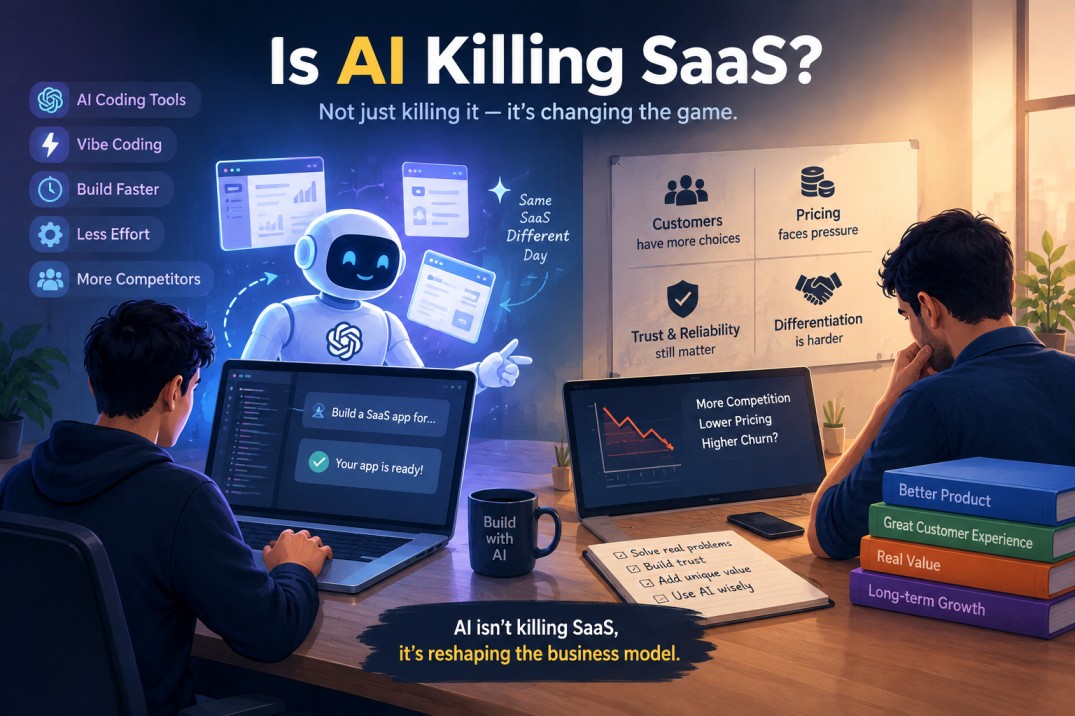
Is AI killing SaaS or changing how SaaS businesses operate? Explore how AI coding tools make software development easier, increase competition, challenge traditional pricing models, and force SaaS founders to rethink customer value, retention, and long-term growth.
I've been reading a lot of tweets on X about one big question: Is AI killing SaaS?
People are worried about the future of the SaaS industry. Companies that have spent years building software now face a new kind of competitor: a developer using AI to build a similar product in a fraction of the time.
With AI coding tools and vibe coding becoming more popular, almost anyone can try to build a software product.
But wait a minute.
When we say AI can copy a SaaS product, what does that actually mean?
It means a new competitor can enter the market more easily than before.
And that changes everything.
The Entry Barrier That Once Protected SaaS Companies
Before AI coding tools became widely available, building software required significant time, technical knowledge, and resources.
Imagine a company that spent years developing a complex software platform. It had to hire developers, write thousands of lines of code, fix bugs, maintain servers, and continuously improve its product.
For a new competitor, building something similar was a huge challenge. It could take months or even years, along with a significant investment.
This created an entry barrier.
Many customers preferred paying for an existing SaaS product rather than spending time and money building their own software.
That was one of the advantages of the SaaS business model: customers paid for a ready-to-use solution, and the software company handled the development and maintenance.
But AI is changing this equation.
AI Isn't Necessarily Killing Software. It's Challenging the Business Model.
You might ask, "Kuldeep, we understand that AI makes development easier. But how does that kill SaaS?"
That's a fair question.
AI isn't making software disappear. Instead, it's making it easier for customers and competitors to build alternatives to existing software.
Think about a SaaS product that solves a specific problem. Previously, building a similar solution might have required a team of developers working for months.
Now, someone with the right technical skills and AI tools might be able to build a basic, working alternative much faster.
It might not have all the features, security, reliability, integrations, or scalability of the original product. But if it solves the customer's main problem, it could be good enough for some users.
And that's where the real challenge begins.
When customers can build an alternative more easily, SaaS companies have to work harder to justify why customers should keep paying them.
A Simple Example: The Rising Cost of an Email Tool
Imagine an independent software developer who has built several small software products.
To send newsletters and other emails to subscribers, he uses a third-party email service. He doesn't want to build and maintain an email system himself, so paying for an existing service makes sense.
Let's say he pays $3,000 per year for the subscription.
One day, he receives an email from the provider announcing a price increase. His annual subscription will now cost $4,000, even though the features he uses haven't changed.
He's frustrated.
Previously, building his own email system would have required too much time and effort. Paying $3,000 per year was the easier option.
But things are different now.
He already understands software development, and he has access to AI coding tools. So he decides to build a basic email system tailored to his needs.
Within a week, he has a working prototype.
It might not offer everything the existing provider does, but perhaps it handles his current requirements well enough to make the switch worth considering.
Now imagine thousands of customers evaluating similar decisions across different software categories.
Some will continue paying for established products. Others might switch to cheaper alternatives, open-source tools, or software they build themselves.
This is a hypothetical example, but it illustrates the pressure AI can create for SaaS businesses.
Everyone Can Build. But Can Everyone Build a Business?
Today, building software is becoming easier. AI companies are encouraging people to turn their ideas into working applications without the traditional development process.
That's exciting for developers, founders, and entrepreneurs.
But there's another side to this change.
When the cost of building software decreases, more people can enter the market. More competitors can offer similar features, and customers get more choices.
This can put pressure on pricing, customer retention, and differentiation.
A product that once stood out because it was difficult to build might no longer have the same advantage.
However, building a working application is only one part of running a successful SaaS business.
Customers also care about reliability, security, support, integrations, data migration, compliance, and the confidence that the software will keep working when they need it.
A working prototype might take a week to build. A dependable product that thousands of businesses trust can be a completely different challenge.
That's why established SaaS companies still have opportunities to compete.
But they cannot rely on development complexity alone to protect their position.
What Should SaaS Companies Do Now?
I believe SaaS founders need to rethink what makes their businesses valuable.
Here are a few things worth focusing on:
1. Solve a real customer problem
Don't build features just because you can. Understand why customers use your product and which problems they cannot easily solve themselves.
2. Focus on customer experience
A reliable product, easy onboarding, helpful support, and a smooth workflow can be more valuable than having the longest feature list.
3. Build deeper value
Integrations, automation, industry-specific workflows, and accumulated customer data can make a product more useful and harder to replace.
4. Rethink pricing
If AI makes alternatives cheaper to build, customers may question expensive subscriptions. SaaS companies need to make their pricing reflect the value customers receive.
5. Use AI yourself
AI is not just a threat to existing software companies. It can also help them develop faster, improve support, automate operations, and serve customers more efficiently.
The companies that adapt can use AI as an advantage instead of treating it only as a competitor.
My Conclusion: AI Is Reshaping SaaS, Not Simply Killing It
I don't believe the story is as simple as AI killing SaaS.
AI is lowering the barriers to software development. It is making competition easier, giving customers more options, and challenging SaaS companies to prove their value.
The old advantage of spending years building something complicated may become less powerful in some markets.
The new advantage could come from understanding customers better, providing a reliable service, building trust, and solving problems that go beyond writing code.
Building software is becoming easier. Building a SaaS business that customers want to keep paying for is still the real challenge.
It will be interesting to see how SaaS pricing, customer expectations, and business models evolve as AI continues to improve.
What do you think? Is AI killing SaaS, or is it forcing SaaS companies to become better?