AI Makes SaaS Development Faster, But Can It Build Great Software?

Written by
Kuldeep Singh
12 Oct 2026
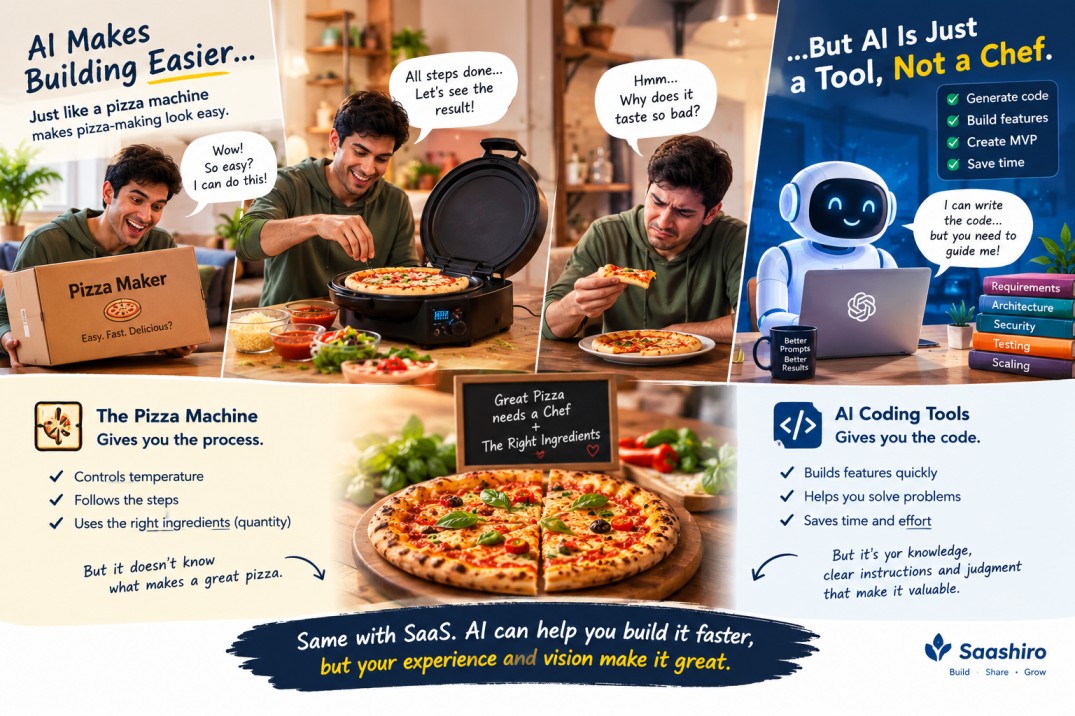
AI is making SaaS development faster and easier, but building great software takes more than a few prompts. Discover what a pizza-making machine teaches us about AI, software engineering, clear requirements, and the human experience needed to build reliable products.
AI Is Helping Us Build SaaS Faster. But Can Everyone Build Great Software?
Yesterday, someone signed up on our website.
Out of curiosity, I checked their details. Something caught my attention: their website name appeared to be an email address. When I looked at the website, I discovered that they were selling clones of several existing SaaS platforms.
I started wondering: Was this person planning to clone our SaaS product, too? Perhaps they thought signing up would automatically give them access to a dashboard or account.
I don't know their actual intentions, but the experience made me think about something important.
We are entering an era where building a software product is becoming easier and faster than ever before.
With a few prompts, AI agents, and coding tools, developers can create working versions of products that once took months to build.
But does that mean everyone can build great software?
I don't think so.
AI Has Changed the Way We Build Software
We also use AI coding tools such as Cursor, Claude, and chatbots in our development projects.
They help us write code faster, understand existing codebases, debug problems, and build features that would otherwise take much longer.
But I've noticed something interesting.
When you give AI a basic prompt, it often tries to complete the task as quickly as possible. It may choose a shortcut that works for the immediate requirement but doesn't necessarily fit the bigger picture of your application.
That's fine when you're experimenting or building a quick prototype.
But building an MVP and building a production-ready application are two different challenges.
A production application needs more than code that simply works.
You need proper validation, error handling, logging, caching where appropriate, secure authentication, and clearly defined public and private API endpoints. You also need to think about database performance, testing, maintainability, and scalability.
For example, telling AI to "build a login system" is very different from explaining exactly how the authentication should work, how sessions should be managed, how unauthorized requests should be handled, and what security requirements must be met.
AI can write the code, but you still need to know what the code should accomplish and how to verify that it does the job correctly.
Why Some Developers Waste AI Tokens
Another thing I've noticed is that developers can get very different results from the same AI tools.
Some use AI efficiently and build features with a clear plan. Others keep sending prompts, fixing the results, changing requirements, and asking the AI to rewrite what it just created.
Before they know it, they've consumed thousands or even millions of tokens without making the progress they expected.
Why does this happen?
Often, the problem starts before the coding even begins.
If you aren't clear about your requirements, architecture, user flows, or roadmap, you may end up asking AI to solve the wrong problem.
Then you ask it to fix the result. That fix creates another issue, so you ask it to fix that, too.
And the cycle continues.
This doesn't mean every development task needs a huge specification document. Small tasks can work perfectly well with simple prompts.
But for complex applications, you need to give AI the right context, define the expected behavior, and break the work into manageable steps.
The better you understand the problem, the better you can guide AI toward a useful solution.
And this reminds me of a funny story about my friend and a pizza machine.
The Pizza Machine That Promised Easy Pizza
One of my friends absolutely loves pizza. And by loves pizza, I mean he loves eating it!
One day, he came across some YouTube Shorts showing how easily people could make pizza using a pizza-making machine.
The videos made it look incredibly simple.
Just add the ingredients, follow a few steps, switch on the machine, and boom! Your pizza is ready.
My friend was excited.
"How difficult can it be? If these people can make pizza so easily, I can do it, too!"
He ordered the machine.
A day or two later, the delivery arrived. He opened the package, took out the machine, gathered the ingredients, and started preparing his first homemade pizza.
He added everything, set the timer, and waited.
After some time, the machine beeped. The pizza was ready!
He was so excited that he invited me over to try his upcoming delicious creation.
When I arrived, he proudly served the pizza.
We were about to eat when I stopped and said, "Bro, you try it first!"
He took a bite.
His expression changed immediately.
"God! Why does this taste so bad? What happened?"
I tried it, too. He was right. It wasn't very good.
He looked confused.
"Bro, I followed all the steps. I added the ingredients and set the timer. Why doesn't it taste like the pizza I get from a restaurant?"
I asked him a simple question.
"Are you a pizza chef?"
He said, "No."
"Then how did you expect to make restaurant-quality pizza on your first attempt?"
He replied, "But the company promised that making pizza would be easy!"
I laughed and explained something to him.
"Yes, the machine helps you make pizza more easily. But that doesn't mean it guarantees that your pizza will taste amazing."
A machine can help you control the temperature, cook the ingredients, and follow a process. A recipe can tell you which ingredients to use and how much to add.
But making a really good pizza also requires understanding the ingredients, their quality, the dough, the cooking process, and how everything comes together.
A machine can help with the process. It doesn't automatically give you the experience of a skilled pizza chef.
My friend had learned an important lesson: making pizza was easy to start, but making great pizza was another story.
AI Is the Pizza Machine of Software Development
Now, let's connect this story to AI.
AI coding tools are like that pizza machine.
They make software development faster and more accessible. They can generate code, create interfaces, build database queries, write tests, and help developers solve complex problems.
Someone with an idea can now build a working prototype much faster than before.
That's an incredible change.
But the quality of the final product still depends on how the tool is used.
If you don't understand the problem you're solving, you might build the wrong thing.
If you don't understand security, you might overlook vulnerabilities.
If you don't understand database design, you might create performance problems.
If you don't test the application properly, you might release something that works in a demo but fails when real customers start using it.
And if you keep changing your requirements without a clear direction, you may spend more time fixing AI-generated code than building your actual product.
AI can help you overcome many of these challenges, but it cannot remove the need to think carefully about them.
The ingredients still matter. The process still matters. And the person guiding the process still matters.
My Final Thoughts
I believe AI will continue to make software development faster, cheaper, and more accessible.
More people will build SaaS products. More competitors will enter existing markets. And many ideas that were once too expensive to pursue will become possible.
That's good news for developers and entrepreneurs.
But building an application is not the same as building a successful software business.
You still need to understand your customers, solve a real problem, make good engineering decisions, test your product, and keep improving it.
AI makes building software easier. Your knowledge and judgment help turn that software into a product people can trust.
You don't need to know everything before you start using AI. But the more you learn about software development, the better equipped you'll be to guide AI, identify its mistakes, and build something valuable.
So, don't just learn how to prompt AI.
Learn how to think, how to build, and how to solve problems.
Because having a pizza machine doesn't automatically make you a pizza chef. And having an AI coding tool doesn't automatically make you a great software engineer.
What do you think? Is AI making software development easier for everyone, or is real engineering experience becoming even more valuable?